A wide range of mathematical models for the evolution of opinions are formulated as agent-based models (ABMs), in which individual agents interact and adapt their opinions over time. In this project, we develop more realistic ABMs for opinion dynamics, investigate their connection to empirical data, derive computationally efficient continuum descriptions, and study how a small number of strategic agents can influence a much larger population.
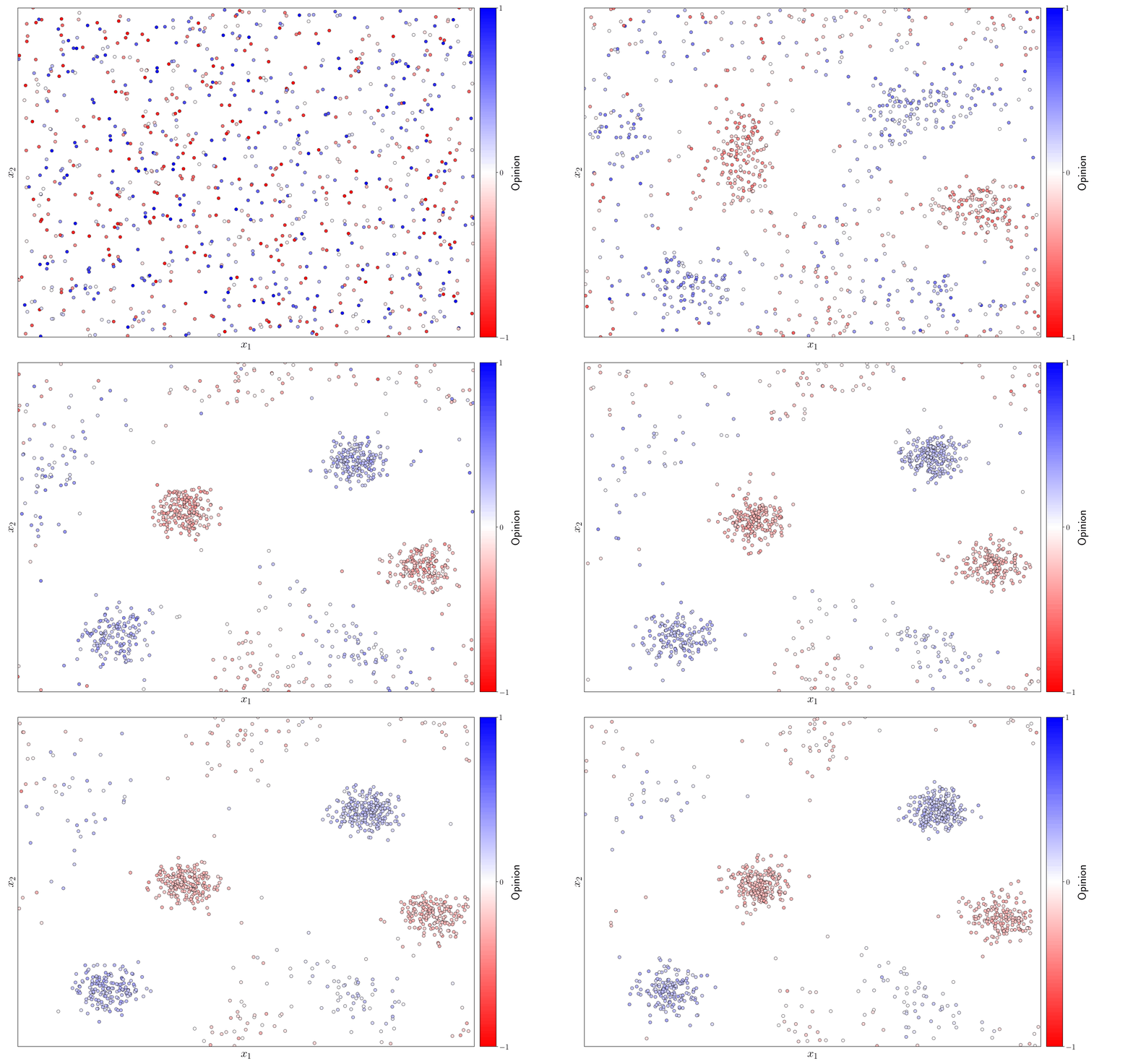
Cluster formation of an ABM.
| An important aim of our work is to narrow the gap between mathematical models and phenomena observed in real systems. To this end, we have developed models that account for the influence of external actors, such as media and online influencers, as well as models in which individuals are characterised by both their opinions and their positions in an underlying social space. The latter framework allows social relationships and opinions to evolve jointly. We have also compared model predictions with data from a large-scale social survey, finding good qualitative agreement with observed patterns. |
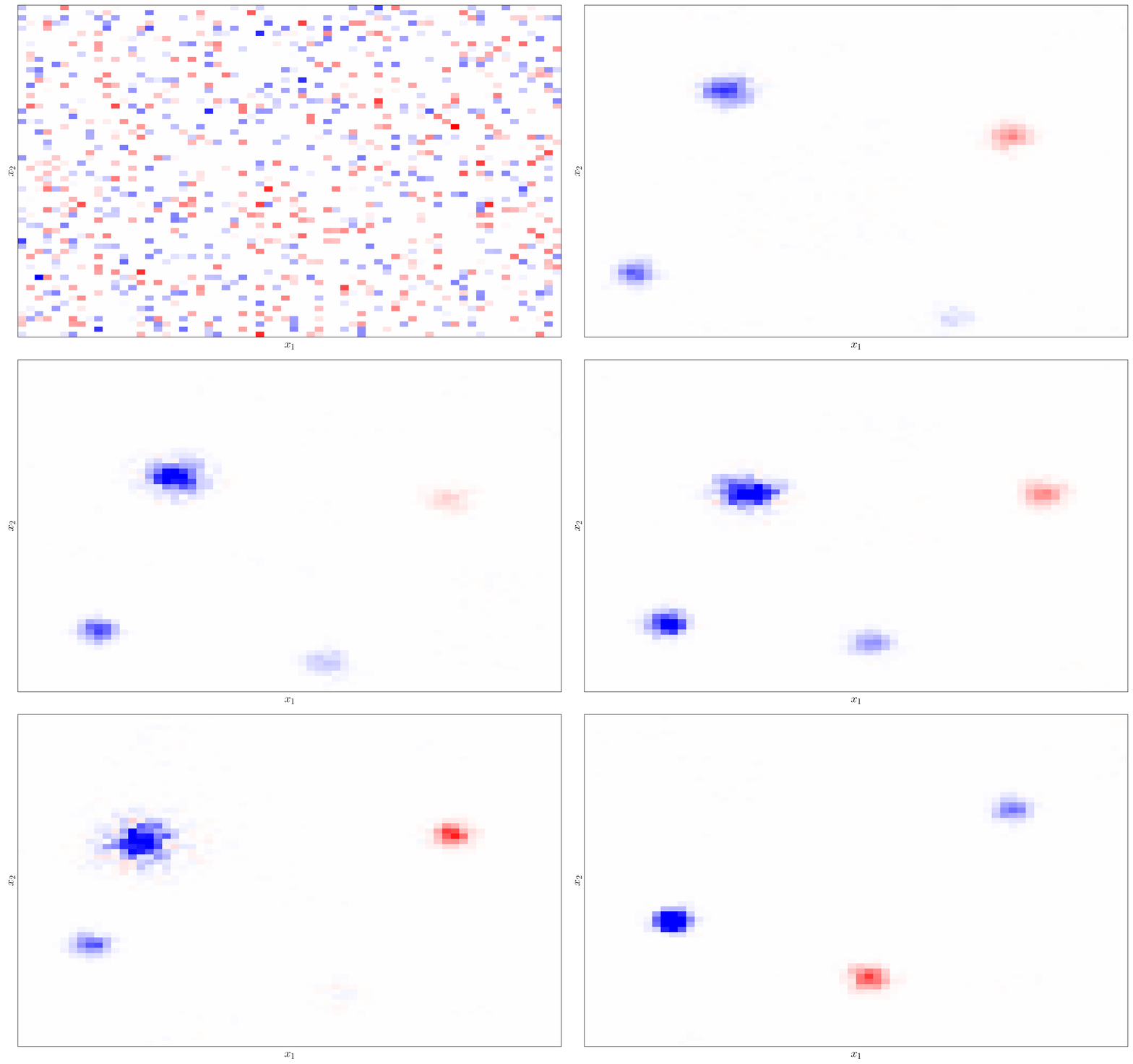 Cluster evolution of a reduced SPDE model. Cluster evolution of a reduced SPDE model. | While ABMs provide a detailed description of individual interactions, they become increasingly difficult to analyse and simulate as the number of agents grows. This motivates the use of continuum descriptions, which capture the aggregate behaviour of large populations. A classical approach is the mean-field limit, which becomes accurate as the number of agents tends to infinity. However, mean-field models are typically posed on the full state space and can therefore become computationally expensive in high dimensions. As an alternative, we have derived reduced continuum models posed on lower-dimensional state spaces. These models are substantially cheaper to simulate while retaining the key collective behaviour of the underlying ABMs. We have also developed stochastic partial differential equation (SPDE) models that incorporate finite-population fluctuations and are able to reproduce the long-term formation and evolution of clusters. |
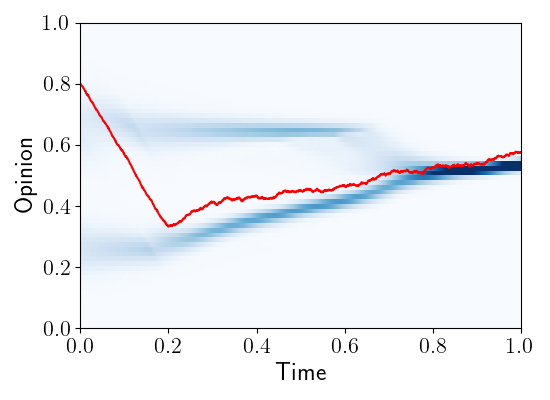 A leader steering the density of agents to consensus. A leader steering the density of agents to consensus. | A further question of interest is how a small number of individuals can influence the behaviour of a much larger population. We study this through optimal control problems in which a small number of lead agents seek to steer a population of followers towards a prescribed objective. Since solving such control problems directly becomes expensive for large populations, we derive corresponding mean-field control problems. We have established rigorous convergence of optimal controls for finite-agent systems towards those of the limiting mean-field model and developed an efficient gradient-based numerical method for computing these controls. As an illustration, we apply this framework to an opinion dynamics model in which a single lead agent seeks to steer the population towards consensus. |

Group
Members
Partners
Ana Djurdjevac - Freie Universität Berlin
Carsten Hartmann - BTU Cottbus
Philipp Lorenz-Spreen - MPI Human Development
Camille Roth - Centre Marc Bloch CNRS/HU Berlin
Funding
Berlin Mathematics Research Center MATH+
Links